
February 25, 2014
Reel Property: “The Attorney” and the Appearance of Justice
(This post is the second and final part in my blog series about the 2013 South Korean film “The Attorney.” Part I can be found HERE)
“The appearance of justice, I think, is more important than justice itself.”
 Tom C. Clark explained in an interview why he resigned as a Justice of the U.S. Supreme Court. President Lyndon Johnson wanted to appoint Clark’s son, Ramsey, as U.S. Attorney General. The Constitution does not forbid a father from sitting on the Supreme Court while his son heads the Department of Justice. Tom Clark observed that although his son may not have anything to do with particular D.O.J. cases before the Supreme Court, the public would associate the outcome of the cases with the father-son relationship. The public develops its perceptions of the justice system more from news reports than personal experience. These perceptions help form the rule of law.
 The 2013 Korean film “The Attorney” reminded me of Justice Clark’s interview. This film is loosely based on the 1981 Busan Book Club Trial. In that case, attorney Roh Moo-hyun, the future President of S. Korea, defended a young man against terrorism charges supported by a written confession procured by torture of the defendants. A few days ago, I blogged about the first half of this film which focused on the attorney’s success building a real estate title registration practice. Today’s post explores the court drama at the climax of the movie.
One evening, lawyer Song Woo-seok (pseudonym for Mr. Roh, played by actor Song Kang-ho) entertains his high school classmate alumni at a restaurant managed by his old friend Choi Soon-ae (Kim Young-ae) and her teenage son, Park Jin-woo (Im Siwan). Song gets into a drunken argument with a journalist who defends the motives of student groups protesting the 1979 military coup. Song is a high school graduate who studied for the bar exam at night after working all day on construction sites. He struggles to understand the students’ idealism. Choi and Park are disappointed and angry about the property damage from the fight at their restaurant.
In a later scene, Park Jin-woo attends a book club meeting, where female students flirt with him about romantic content in a novel. The authorities raid the meeting and secretly take the students, including Park, into custody. Mrs. Choi searches for him all over Busan, even visiting the morgue. After many days, the authorities informed her of Park’s pending trial for crimes against national security. Choi begs Song to defend Park. Song’s loyalty to Choi and his journalist classmate overcome his reluctance to accept a perilous, politically-charged criminal case.
1. Personally Investigate the Real Property Before Trial
When attorney Song and Mrs. Choi visit Park in jail, his fatigued body is covered with bruises. Song interviews Park and his co-defendants about their arrest and detention. They describe the sounds of the street they heard from inside the interrogation location. Song locates and explores the mysterious building.
When I started litigating real estate cases, attorney Jim Autry explained to me the importance of a discreet first-hand view of the property at issue, including value comparables supporting an appraisal. Song’s risky investigation of the decrepit building where the police conducted the interrogations reflect his real estate and construction background. This on-site investigation allows him to interpret the documents and witness statements and try the case with confidence.
2. Verdict Preferences Develop Before Conclusion of the Evidence
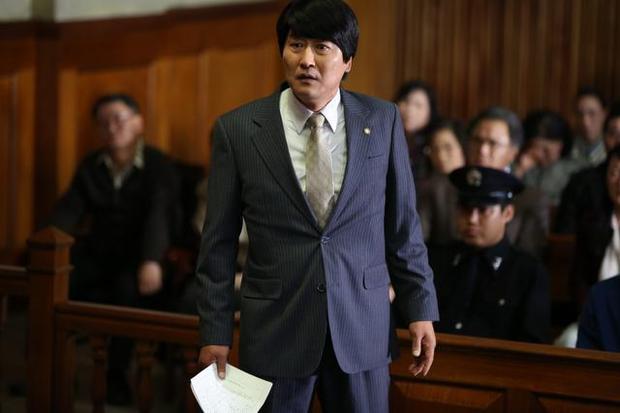
This trial drama defies a conventional legal analysis because the verdict appears politically predestined. Attorneys going to the theater to see taut repartee under the rules of evidence will be disappointed.
The case is tried without a jury. Beforehand, the judge privately requests that defense counsel refrain from making a lot of objections and motions in front of the news media. The judge makes several early evidentiary rulings against Song and the defendants. Everyone anticipates a show trial imposing the political will of the military junta.
Song bravely transforms the case into more than a show of power. In interrogation, the defendants signed confessions that they read British historian E.W. Carr’s “What is History?” in their book club. The prosecution presents an expert who testifies that this book is revolutionary propaganda. On cross-examination, Song shows that this is required reading in the leading universities in South Korea. Song also tricks the prosecution into admitting that the expert’s offices are in the same building as the government’s intelligence service. This challenges the independence of the expert’s opinions.
3. False Confessions
Song calls Defendant Park to testify. Park explains that he signed the confession after many days of torture by the police. When Song presents photographs supporting the witness’s testimony, the prosecution argues that the wounds were self-inflicted.
Even without torture, false confessions are a common problem in criminal justice. Virginia Lawyers Weekly recently reported that 1/4 of all convicted defendants later exonerated by DNA made false confessions. Feb. 17, 2014, “Untruth or Consequences: Why False Confessions Happen and What To Do.” “Good cop/ bad cop” routines intimidating young, vulnerable defendants often lead to “confession” of details introduced by law enforcement during interrogation. Id.
4. Effect of Visceral Reactions of Courtroom Observers on the Trial Proceedings
Park’s testimony about the torture techniques brings the courtroom audience of family members and local media to tears. The authorities replace the families on the next day with a mob seeking a guilty verdict. Song’s examination of the police detective is a failure. The officer evades Song’s questions and lectures him about the threat of terrorism.
Just as the defense seems to peter out, Song and Park get a big break. Song meets the army medic used by the interrogators to keep Park alive during the interrogation. The medic courageously resolves to testify for the defendants about the nature and extent of the injuries. Song’s journalist classmate agrees to contact international media organizations in a desperate attempt to put pressure on the authorities about the medic’s testimony. The outcome hinges on the admission and credibility of the medic’s testimony.
5. Conclusion
Hollywood court dramas indulge their audiences with conclusive vindication. “The Attorney” reminded me that a system of justice is always a work in progress. Song evolves from construction laborer to moneymaking genius to litigator. Finally he becomes a civil rights leader motivated and tempered by his training and experience.
Song voice seemed frequently shrill during the trial. Perhaps a Korean speaker can comment on whether this was persuasive or detracting.
When a case turns into an uphill battle, attorneys sometimes rationalize that, “This could be worse.” The defense counsels’ role in the 1981 Burim trial must have been one of these worst-case scenarios. Average trial lawyers succeed for their clients when they can marshal favorable law and facts through in a legal system that works well. “The Attorney” presents an extreme case showing how courage, intelligence, loyalty and tenacity can earn the respect of colleagues, and in rare cases, a nation.
Perhaps Justice Clark would have respected Roh’s commitment. The villains in “The Attorney” see the criminal justice system as a blunt weapon and propaganda medium for use against critics of the military coup. This ultimately undermines the credibility of the legal system and weakens the rule of law. Attorney Song’s courtroom theatrics aren’t to make money or to cloak his personal insecurities. He takes risks out of deep loyalty to his client. Truth, not bullying, enhances the “appearance of justice.”

February 20, 2014
Reel Property: “The Attorney” (Korean, 2013)
Before Roh Moo-hyun became a human rights advocate and President of South Korea, he was a lawyer in private practice. Director Yang Woo-seok loosely based the 2013 Korean movie The Attorney (Byeon-ho-in) on Mr. Roh’s early career. After a blockbuster run in S. Korea, “The Attorney” now appears in American theaters. On Presidents Day, my wife and I watched this film, coincidentally featuring a foreign president. “The Attorney” has his weaknesses, but captures what it means to be an advisor, entrepreneur and advocate.
Song Kang-ho plays lawyer Song Woo-seok, a fictionalized, young Roh. Mark Jenkins observes that “The Attorney” begins as a comedy about a pioneer in land registration practice in Busan, Korea. Like a lawyer changing focus mid-trial, director Yang shifts gears in the middle of the film. Song accepts the defense of a young waiter who, after brutal torture, “confessed” to fomenting overthrow of the government. See Mark Jenkins, Feb. 6. 2014, Wash. Post, “‘The Attorney’ Movie Review: An Earnest and Instructive South Korean Box-Office Hit.”
 Part One of this blog series focuses on Song’s success building a residential settlements practice. Part Two will focus on his trial preparation and advocacy for victims of human rights abuse.
1. Don’t Give Up – Re-calibrate and Move On:
Song pulls himself by his boot straps by maintaining a positive outlook. Before Song conducted legal settlements of homes, he literally built them. When I watched this film, I personally identified with the title character. After a day on the job, Song washes the construction site grime off his hands and starts to study. Your humble blogger worked as a laborer for a construction company during his college years. Song studied law in the evenings in neighborhood restaurants and unfinished buildings. I attended law school in an evening program while working a normal day job. A few years ago, I discovered culinary gems in Northern Virginia’s Korean restaurants. The restaurant scenes in the movie made me feel hungry!
After dinner at a restaurant managed by Choi Soon-ae, Song skips out on the bill. The dinner money goes to buy back his pawned law books. Song motivates himself by writing “Never Give Up” on the textblock of his books and into concrete facades at work sites. Song has little education or money to support his family or pay his debts. He uses “Never Give Up” to reinforce a positive outlook in the face of adversity. Writing or sharing a constructive affirmation can overcome self-doubt or the negativity of others.
2. Fearless Niching & Frequent Networking:
After passing the bar, Song receives a judgeship. Struggling to support his family, he resigns to found a real estate registration practice. This practice is similar to that performed by title companies and settlement agents in the U.S. Song capitalizes on a rule change authorizing attorneys to do work previously restricted to notaries public. Initially, his bar association colleagues scorn him for doing work they consider beneath them. At a bar meeting, he overhears them gossiping as they sit down to eat at his table. They complain that he is out meeting people and handing out business cards. Unperturbed, Song introduces himself and hands out his cards.
After Song finds financial success, his rivals follow him into this practice area, competing for the same customers. He reinvents himself again as a tax law advisor. Song’s vision and lack of pretension distinguish him from his colleagues. He fit his own background and talents with a high-volume consumer practice. Years after failing to pay the dinner bill, the new attorney returns to Mrs. Choi’s stew-house to repay his debt. She refuses, with motherly joy for a prodigal patron, insisting that he become a regular customer.
“The Attorney” features a foreign legal system and a different culture. I relied on the subtitles to follow along. In spite of cultural and linguistic barriers, the first half of the movie shows universal entrepreneurial strategies. Another WordPress blogger, Seongyong, has great photos from the film in his post.
In the first part of the film, the director develops Song’s character as worldly, warm & family-oriented. In the second half, Song puts his career, reputation and safety on the line to oppose anti-terrorism charges based on confessions procured by torture of the client. Stay tuned to the next blog post!
)

January 28, 2014
Divorce, Family Homes and Elliot in the Morning
On my Friday morning commute, I heard a guest on the radio show, Elliot in the Morning talking about his parents’ divorce, marriages and the legal fate of a family home. I rarely partake of EITM, but this time I stopped to listen (relevant portions of recording between minute marks 8:20-16:30 on YouTube).
Tommy Johnagin on Elliot in the Morning: Comedian Tommy Johnagin explained that when he was seven, his mother divorced his previous stepfather and married Johnagin’s current stepfather (none of this takes place in Virginia). The families lived in a small town. The current stepfather previously built a home with his own hands for himself and his ex-wife. When the current stepfather and his ex-wife divorced, the ex-wife got the house. Johnagin’s mother’s previous husband then married her current husband’s ex-wife (confused yet?). So Johnagin’s previous stepfather is now living in the home built with the sweat of the current stepfather’s brow. Johnagin commented to Elliot Segal: “I don’t even understand how this works.” In this portion of the interview, I was impressed with how Johnagin weaved some earthy insights into family life with funny personal narrative, such a recent chance encounter with the previous stepfather in the checkout line at the local Wal-mart.
What are the ways a family home can possibly reach this kind of outcome in divorce? Although the facts are different, the Supreme Court of Virginia published a January 10, 2014 opinion, Shebelskie vs. Brown, that discusses a possible route.
Betty & Larry Brown in the Virginia Court System: Betty and Larry Brown completed a divorce in Florida. One of their homes was Windemere, a landmark Tudor mansion in Richmond. (V.L.W. subscribers see July 22, 2013, “A Partition Suit Blows Up,” Virginia Lawyers Weekly) Sometimes, when an out-of-state divorce requires divvying up Virginia property, the parties will file an Equitable Distribution action in Virginia and the house matter will be referred to a court-appointed Commissioner. For reasons not discussed in the court opinion, this phase of the Brown divorce did not proceed this way. Instead, Larry filed a partition suit in Richmond, seeking an order that Windemere be sold.
In Virginia, when co-owners of real estate cannot agree on what to do with real estate, one party may file with the court a request for Partition and a Judicial Sale. See, Va. Code section 8.01-81, et sec. Partition traditionally involves dividing the parcel equitably into smaller parcels. When the land cannot conveniently be divided into smaller chunks because that would destroy the value of any improvements, the Court will usually grant a sale of the entire property. The monetary proceeds of the sale are then divided. Lawyers try to use partition suits as a last resort because they are a very expensive way to sell a house and more likely to lead to further title litigation. The deputy clerk called the Browns’ names week after week on the Richmond Circuit Court motions’ docket. The Court ordered a Judicial Sale. Finally, Betty obtained confirmation from the Court that she could go to closing on the house to buy-out Larry. The facts suggest that spousal support owed by Larry would end up helping to pay for the buy-out.
In the trial court, the parties litigated over attorneys’ fees and awards of sanctions issued by the judge against some of the attorneys. On appeal, the Supreme Court of Virginia reversed the sanctions award. (I invite my trial lawyer readers to take a look at the Court’s interpretation of the term, “motion” in the sanctions statute)
The Stepfather’s House, Revisited: How does the house that one man built for himself and his family end up in the possession of his ex-wife and his current wife’s ex-husband? Most likely, the home was part of the marital estate in the divorce and went to the ex-wife either in a settlement or by court order.
In a way, Tommy Johnagin’s current stepfather should be flattered that both his ex-wife and her subsequent husband desired the house he built. As a builder, he can construct another one.
In the interview, Johnagin commented that he felt content with the stepfather he got in the step-parent “lottery.” In the end, a good stepfather makes a bigger difference in someone’s life than title to a mansion or an appellate court victory.
photo credit: » Zitona « via photopin cc


January 24, 2014
Title Litigation: Centenarian Deed Decides Methane Royalty Rights
On January 10, 2014, the Supreme Court of Virginia decided CNX Gas Company, LLC v. Rasnake, interpreting disputed language in a 95-year-old deed. The Court determined who owned the mineral rights in a parcel of land in Russell County in Southwest Virginia. The contested deed contained both (a) words conveying a parcel and (b) limiting language that excepted certain property from the transaction. Ultimately, the words of conveyance prevailed over the words of limitation! The opinion is a useful collection of some of the rules about how to prepare, interpret or litigate a deed.
In 1887, Jacob & Mary Fuller conveyed the coal in a 414 acre tract in Russell County to Joseph Doran and W.A. Dick. In 1918, W.T. Fuller conveyed to Unice Nuckles a 75 acre portion of the Fuller family tract except that, “[t]his sale is not ment (sic) to convey any coals or minerals. The same being sold and deeded to other parties heretofore.”
Over 90 years later, CNX Gas Company holds a lease from the successor to Ms. Nuckles for the mineral rights (excluding coal) in the 75 acre tract. CNX produces coalbed methane from the parcel. Coalbed methane is a natural gas extracted from coal mines and sold as energy. The opinion does not discuss how methane is a “mineral.” The parties likely stipulated to that based on authorities not mentioned. The successors to W.T. Fuller sue CNX over the non-coal mineral rights. To resolve the dispute, the Court has to decide what the above-quoted language meant. Have the non-coal mineral rights been legally conveyed or not? Royalties to the coalbed methane hang in the balance.
When I initially read these facts, I wondered if perhaps I was missing something. Did the 1887 deed say something about non-coal minerals? Was there some other deed prior to 1918 conveying the minerals? Perhaps there was an unrecorded deed known to the parties in 1918. Since the opinion states the parties stipulated to the facts, the title examination must have revealed the answer to both questions to be “no.”
The Supreme Court of Virginia applied the following legal rules to resolve the title dispute:
- Is the language capable of being understood by reasonable persons in more than one way? One could assume the answer to be “yes,” since the issue found its way to the highest court in the Commonwealth. But lawyers have a reputation for torturing unambiguous language, so the question is appropriate. The Supreme Court found the deed ambiguous.
- Which interpretation favors the grantee (recipient)? Since the Grantors (usually sellers) are the ones who sign the deed conveying the property, it is only fair to assume that they chose their language carefully.
- Can the language of the deed be considered holistically? Since W.T. Fuller included all of those phrases in the deed, it is reasonable to harmonize them rather than pick and choose certain sections that favor one side over the other.
- Is the limiting language clear and unequivocal? A deed must have, among other things, words of conveyance, which generally describe the lot or parcel of land transferred. A deed may also include other language limiting or reserving certain interests excepted from the transfer, such as certain mineral rights. Unless the limiting language contrary to the general grant is expressed clearly and unequivocally, it will not be upheld in court.
The Supreme Court of Virginia applied these rules to find that the only “coals or minerals” not included in CNX’s leasehold interest are the coal rights conveyed to Joseph Doran and W.A. Dick in 1887. The Court entered judgment upholding CNX’s rights to extract the coalbed methane from the 75 acre tract. Words of conveyance prevailed.
P.S. – There is one other principle that the Court could have mentioned: when interpreting legal documents, the specific prevails over the general. Since the 1914 deed made reference to previous conveyances of natural resource rights, the plaintiffs’ stipulation to the absence of any other deeds locked them in.
